We discuss: Graphics design, Web hacking/cheats and web design, Full blogging gists, Health and Fitness, sports and recreations, More gists and stories, News and updates, Gossips and lifestyle, entertainment and inspirations..
According to a recent study, many millennials say they would end a relationship for a promotion at work.
3 min read
Opinions expressed by Entrepreneur contributors are their own.
Millennials often get a bad rap in the workplace, but the reality is many of these young people are extremely hard workers and willing to make sacrifices to get ahead in the workforce.
To find out exactly what these young people are willing to give up for their careers, financial intelligence company Comet surveyed 364 employed millennials who are single and don't have children and asked them whether, and to what extent, they would put their work before relationships.
For many millennials, it’s about the money. With a focus on their finances, 41 percent said they would end a relationship if it meant getting a major promotion at work. In fact, if offered a life-changing promotion, the average surveyed millennial said they would stay single for 11 years, delay marriage for seven years and wait to have kids for eight years. However, while many millennials might give up dating, when it comes to long-term relationships, it’s a different story. To the contrary, millennials are willing to make job sacrifices for a long-term relationship that has a promising future: Over half of respondents said they would give up a career opportunity in exchange for a long-term relationship and 86 percent said they would move to another city if their significant other was offered a better job.
While focusing on their careers is one of the reasons the surveyed millennials said they chose to stay single, some avoid relationships for entirely different purposes. The top reason is because they are are “picky.” Others say it is because they haven’t found anyone or dated much, don’t go out enough or simply haven’t found someone they liked enough to date.
Overall, the study found that millennial men were more willing to make sacrifices for their careers than millennial women. According to the research, it would take men an average raise of $21,000 to choose to delay a relationship, while women said it would take a whopping $51,000 to make the same sacrifice. The same was true for delaying marriage and kids. On average, men said a $37,000 raise would influence them to delay marriage, while woman said it would take $93,000. Millennial women were also less likely than men to end a relationship if it meant getting a major promotion or pass on a long-term relationship if it jeopardized their career.
Today’s episode is a vital one for all you podcasters out there. I’m sharing my top tips for preparing for a podcast interview, gathered from the hundreds of interviews I’ve done on the Smart Passive Income Podcast.
Don’t make the mistake of viewing interviews as an easy opportunity to kick back while your guest does all the work. While you should always let your guest do most of talking, you (as the interviewer) have a responsibility to prepare. It’s your job to ensure the interview runs smoothly, stays on schedule, and provides value to your audience.
In this episode, I’ll share my tips for becoming a master interviewer. I’ll cover crafting the perfect questions, preparing your equipment, avoiding scheduling roadblocks, putting your guest at ease, and lots more.
I also recommend checking out PodcastingTutorial.com, my step-by-step guide to getting started with podcasting.
Thanks so much for watching SPI TV, and be sure to subscribe (via YouTube or iTunes) to get new episodes of SPI TV delivered to you each week!
Jessica Abo sits down with attorney Scott Sisun to find out what your company may need when it comes to intellectual property.
1 min read
Opinions expressed by Entrepreneur contributors are their own.
If you’re just starting your business, it’s important to protect your assets. Jessica Abo sat down with Scott Sisun of Sisun Law to help you understand what marks you need and how to protect them.
Entrepreneur Network is a premium video network providing entertainment, education and inspiration from successful entrepreneurs and thought leaders. We provide expertise and opportunities to accelerate brand growth and effectively monetize video and audio content distributed across all digital platforms for the business genre.
EN is partnered with hundreds of top YouTube channels in the business vertical. Watch video from our network partners on demand on Amazon Fire, Roku, Apple TV and the Entrepreneur App available on iOS and Android devices.
It’s my pleasure to welcome back a very special “student” of Smart Passive Income. Kenneth Kelly joins me once again to share how MagicTricksforKids.org has transformed over the past two years, as well as the innovative strategy he’s used to build his growing network of affiliates.
Since Ken’s last visit in Episode 101, his business has grown to include a book and tons of new resources at MagicianBusiness.com. Despite his success, however, he struggled to find affiliates. Most potential partners in his niche aren’t “plugged-in” people—they operate brick-and-mortar stores and do the majority of their business offline.
Ken changed that. Using a clever strategy, he’s acclimated offline business owners to the online world, turning former “techno-phobes” into enthusiastic affiliates.
Today, Ken offers a step-by-step walkthrough of the four-part strategy he uses to earn these affiliates. He’ll share his advice for navigating a competitive niche, the tools he uses to manage his partnerships, and the obstacles he’s overcome along the way. He’s even created an exclusive case study resource that breaks down each step of his strategy, just for Smart Passive Income Podcast listeners!
I love having guests return to the show to share their progress. If you like success stories and super-actionable strategy, you’ll love this episode, too!
Thanks for Listening!
Thanks so much for joining me again this week. Have some feedback you’d like to share? Leave a note in the comment section below!
If you enjoyed this episode, please share it using the social media buttons you see at the bottom of the post.
If you have any questions, head on over to AskPat.com. This bite-sized show has more than two million downloads and counting!
And finally, don’t forget to subscribe to the show on iTunes to get automatic updates, or even better, download the new SPI Mobile App,nowavailable for both iOS and Android. It’s free!
Thanks to Ken for joining me this week. Until next time!
If you install the latest patches, the only attacks you need to worry about are the ones that have already occurred.
5 min read
Opinions expressed by Entrepreneur contributors are their own.
If you’ve been paying attention to tech news lately, you’ve probably heard about Meltdown and Spectre. Their names sound like comic book supervillains, but in reality, they’re as capable of wreaking damage as are Magneto and Venom -- except that they damage businesses.
If you're a business owner, you need to understand what your resulting vulnerabilities are and what you can do to protect your business.
What are they?
Essentially, Meltdown and Spectre are known security bugs that have the potential to affect nearly every computer or digital device in the world. Most security bugs affect either hardware or software -- for example, they might come from a problem with the way your device was constructed or represent a vulnerability to outside influence associated with the back-end code of an app or specific program.
Meltdown and Spectre are different: They exist at an architectural level within processors. Inside a kernel, the core of a computer’s operating system, data passes through in a plain, unencrypted form. Within the system, there are powerful protections designed to shield this unencrypted data from being observed or interfered with by outside sources.
Yet Meltdown and Spectre techniques are able to get around those protections. Hypothetically, this allows them to observe any actions you take on a computer, such as typing out a password, accessing private information or sending encrypted communications.
Meltdown, specifically, affects Intel processors, and exists as a kind of brute-force attack, breaking through the shield that prevents applications from reaching the kernel memory.
Spectre, meanwhile, affects Intel, AMD and ARM processors. And that means it can affect smartphones, wearables and almost anything with a chip in it; rather than breaking down a barrier, Spectre works by tricking an application into revealing ordinarily protected information.
How they were discovered
Meltdown and Spectre were initially discovered -- and given cute names and logos -- independently by three separate teams operating around the same time. Those team members included Jann Horn of Google Project Zero, Werner Haas and Thomas Prescher of Cyberus Technology, and Daniel Gruss, Moritz Lipp, Stefan Mangard and Michael Schwarz of the Graz University of Technology.
The timing of those discoveries, within mere weeks of one another, seems surprising, given that these bugs had been present for more than 20 years. However, the coincidence actually wasn't that surprising: Many bugs are discovered by multiple teams independently and around the same time, even if they’ve been dormant but existent for years.
There are many possible explanations, including the fact that multiple teams might be inspired or prompted by the same circumstances and that teams tend to withhold such information until the bug is discovered by others.
Should you panic?
The worst-case scenario is a bad one. If someone has been using Meltdown and Spectre to spy on your devices, they could easily steal your passwords and compromise your data. And, because almost every device in the world is affected on some level by these vulnerabilities, you aren’t immune from the possibility.
If hackers got to your device before the bug was discovered, your information may already be compromised.
Even so, there’s no reason to panic. There are software patches for both Meltdown and Spectre, which effectively guard against their use. If those patches are applied, you’ll be protected from present and future attacks -- though if you’ve already been affected, there’s no way to retroactively undo that damage.
What you should do right now
So what should you do to deal with these vulnerabilities? Four things:
Update your devices. Take whatever personal and professional devices you have and make sure they’re equipped with the latest OS and software updates. If you have your devices updating automatically, this should have already taken place -- but it never hurts to double check.
Keep an eye on your important accounts. Just in case your device was affected before the patches were applied, keep an eye on your most important accounts. If you notice any suspicious activity, report it right away.
Change your passwords. As an extra precaution, consider changing your passwords, and choosing strong, multi-character passwords as your replacements.
Watch the news. Keep an eye out for more updates in case the story develops.
Meltdown and Spectre were scary because they've taught us a valuable lesson: Security bugs and vulnerabilities can lurk anywhere, sometimes for decades before they’re discovered. But these bugs, in particular, are officially squashed -- assuming you've installed the requisite patches.
If you install the latest patches, the only attacks you’ll need to worry about are the ones that have already occurred. And if you monitor your accounts carefully, you can respond to any suspicious activity immediately.
Are you ready to start your podcast? In this post, I guide you through the process of planning your podcast launch, so that you can make the biggest splash possible on your launch week.
Pat Flynn
Podcasts are huge nowadays. It seems like there are podcasts for every subject, from fiction storytelling podcasts like Welcome to Night Vale to entrepreneurial podcasts like Chris Ducker’s YouPreneur and everything in between.
It’s a wonderful time to be a podcast listener! It’s also a wonderful time to be a podcast creator.
In this post, I am going to jump into a number of specific tips to guide you as a new podcast creator and help the launch of your your podcast be as successful as possible. Sound like a plan? Let’s get into it!
Tip 1: Start With My Complete Step-by-Step Podcasting Tutorial
In How to Start a Podcast: Pat’s Complete Step-by-Step Podcasting Tutorial, I describe each step you need to take to create a successful podcast, from creating your podcast title to choosing the best podcasting gear. This is the best place to start if you’re launching a podcast. Even if you have already launched a podcast, and you’re gearing up for an exciting relaunch, my tutorial can help you take your podcast from stagnating plateau to climbing up the mountain toward more listens, downloads, subscribers, and higher rankings.
Creating a podcast takes a lot of hard work and determination. So you want to make sure that the work you’ve put into it gets the proper attention it deserves (there’s nothing worse than working tirelessly to produce a thing only to find that it didn’t have much of an impact). The best way to do that is to make your podcast launch an event—with a big celebration and announcement, fireworks (figurative or real, it’s up to you!) and all. You want to make a big splash. The bigger the splash, the more ears perk up, which leads to more subscribers, higher rankings, and the potential for more customers down the road.
So, how do you do this exactly? The first thing to do is to have a deadline, or a specific launch date that is transparent to your audience. This way they know exactly how you’re progressing and when the podcast will ready to. It can also be pretty self-motivating—if your audience is aware of your launch date, you’ll be more keen on meeting your self-imposed deadline.
Tip 3: Build the Buzz
If you want to make sure that your podcast launch is an exciting event, focus on the buzz. And I don’t mean bees (although if your podcast is about bees, then you’re good!). By building buzz, I mean putting pieces in place that will strategically inspire excitement and anticipation leading up to the launch date.
One way you can accomplish this is by working backward from your launch date and determining the other dates that make sense to market and/or promote your podcast. I’d recommend putting together a calendar that includes each of the days you want to highlight the podcast launch on social media, your blog, or elsewhere. For the launch of Will It Fly?, we created a social media strategy that followed the same logic with the goal of building buzz before the book was even published. It was pretty successful too!
Pre-launch buzz-building social media strategy for Will It Fly?
Tip 4: Social Media is Your Friend
Just as social media was integral to the Will It Fly? book launch, it can also be important for your podcast launch. Your social media (Facebook, Twitter, Instagram, etc.) followers are part of the community you’ve created. They are naturally an extension of the things that you like, so it makes sense to bring them into the excitement for your next great thing.
A few things you can do to utilize social media:
Podcast Graphics/Logo: When you have your podcast logo or graphics completed, you can share those to give people a visual sense of your show. You can even share your work-in-progress versions of your logo and ask your audience to respond with their thoughts. This gives your followers that warm sense of creative collaboration.
Podcast Clips: Share short fifteen-second clips of your podcast leading up to your first episode. This also gives your community a sense of the podcast, using a short and sweet preview. Focus on a quality clip that will inspire them to subscribe.
Quote Graphics: Similar to podcast clips, you can mine your launch content for valuable little snippets and turn them into eye-catching quote graphics. Include a countdown to launch day in your social media post to keep your audience jazzed.
Tip 5: Compile an Email List
Throughout your preparation for your podcast launch, you should definitely be building an email list. This can be done simultaneously as you build buzz and market your podcast on social media. A few ways you can inspire folks to subscribe to your email list is to send insider information to people on your email list, something exclusive and beyond what they might get by following you on social media.
You could offer up a small glimpse into the structure of your podcast, the main focus of the podcast, upcoming guest appearances, and the reason why you’re creating a podcast in the first place. Remind your audience that, when they do sign up, they’ll be the first to hear about special offers, fun tidbits about the podcast, information about how to access the show, and details about the launch day festivities.
In the many years that I’ve been podcasting, one of the coolest things I’ve learned is that you can actually submit your podcast to iTunes before your launch date. I recommend doing this so that, when your launch day arrives, everything is ready to go. The last thing you want to do is not prepare in advance, have your launch date set but no show to promote because it hasn’t yet been accepted by iTunes.
A good example of this happened during the Will It Fly? launch. When launch day arrived, the Kindle version of the book was still in the approval process at Amazon. Eek! And, because we wanted to meet our launch deadline (after all, that was the expectation we set with my audience!), we had to push forward without the Kindle version. Even though it had been submitted, we didn’t allow enough time to ensure it was approved before launch, which was a mistake. You don’t want the same thing to happen to your podcast on iTunes.
You definitely want to make sure you give at least twenty-four to forty-eight hours for your show to appear on iTunes. When it does appear on iTunes, share an email with your list announcing that your podcast is live and ready for them to enjoy.
Tip 7: Create a Launch Team
One tip that I wish I would have known about when I started my own podcast is the amazing contributions a podcast launch team can add to your push. Thankfully, I was able to capitalize on this value when I launched Will It Fly? and worked with Daniel Decker on a creating a book launch team (you could apply the same tips for your podcast launch!).
Launch teams typically include people you trust and and whose opinions you respect. They are folks who are part of your community, eager to help support your creative output, and thrilled to get exclusive and early access to it. For your podcast, you can do the same.
Gather a group of people who are excited about you and your podcast. Give them early access to the podcast so they can listen to it, critique it, and be involved in your tweaking of it. This makes them part of the creative process. You could even ask them to provide feedback on which episode should go first, who the guests should be, and things of that sort. You could also ask them to share their honest feedback with an iTunes review.
Bonus Tip: Reward a member of your launch team with a guest spot on your podcast! You could talk about the launch team, its purpose, and how the guest contributed to the launch.
Tip 8: Pump Up the Launch Day Volume
Similar to how you want to build buzz before your launch date, the focus should be on making as much noise as possible on the launch day itself. This helps iTunes rankings and leads to greater exposure for your podcast.
A smart way to do this is to compile as many podcast-promoting assets as you can prior to the launch day and have them at the ready to post on social media, your blog, and anywhere else that makes sense. These can include audio clips, quote graphics, testimonials from folks on your launch team, iTunes reviews/ratings, and so on. As I mentioned before, the bigger the splash, the better!
But why?
Well, iTunes rankings are based on the number of subscriptions, downloads, reviews, and ratings collected in the short period of time following your podcast launch on iTunes. So, if you can plan it properly and pack all that activity immediately after your itunes launch, you’ll see greater results.
Bonus Tip: One amazing way to really boost your podcast is to try to be a guest on other podcast shows. This will allow you to build relationships with the podcasting community as well as allow you to promote the launch of your own podcast. It’s best when your guest spot is on a podcast that is a good fit for your audience too.
Tip 9: Launch with Multiple Episodes
When you launch, make sure that have multiple episodes to show. It gives your listeners more to chew on, more to respond to, and ponder. There’s more of a discussion there, which can lead to some great social media back and forth. I once launched a podcast with a single episode and actually received negative reviews from people who had listened to the first episode and were upset that there was only one. When people love your stuff, they’re going to want more of it, so give them what they want. I recommend launching with three to five episodes.
Sound overwhelming? It doesn’t have to be! What helps me is to plan ahead so that both you and your audience know what’s coming. Add your multiple launch-day episodes to a content calendar so that you can preview what’s on the horizon (that has worked out incredibly well for me!).
Tip 10: Hold Nothing Back and Have a Blast
Yes, that’s right. The nine tips that come before this don’t amount to much if you’re not giving it your best shot and having fun while doing it. Your podcast is the result of countless hours of hard work and creative toil. You should be proud of it. Now get out there and make it as successful as can be!
I look forward to hearing about your podcast launch stories. Let me know it goes! If you’ve launched a podcast before, what tips have worked for you?
Thanks as always for reading and happy podcasting!
https://assets.entrepreneur.com/images/misc/1518975155_Screenshot at Feb 18 11-22-02.png [ad_1]
Follow these six Google Shopping tricks to elevate your ecommerce sales.
9 min read
Opinions expressed by Entrepreneur contributors are their own.
In theory, Google Shopping is simple. You upload your products to a feed through Google Merchant Center, connect it with Adwords and voila, your product images and price will start to populate on Google’s search results.
If you are an entrepreneur looking to get started on Google Shopping, Adwards has a video tutorial that walks you through setting up a campaign in under 5 minutes.
Just so you have a visual representation of how Google Shopping works, below you can see how a product from your website will populate via an image after someone conducts a Google Search for the product name. If you have the right Google Shopping strategy, this can be a lucrative way to grow ecommerce sales.
The issue with Google Shopping is that you lack control, which means you can spend a lot of money without being profitable (unless you follow the hacks below). With Google PPC, you bid on keywords and your advertisements will only populate if people search for those specific keywords. I wrote an article on Single Keyword Ad Groups (SKAG) that details how controlled you can get with Google PPC.
Google Shopping pulls in product information from the title of your product along with information on your website, so there are much more search terms that can drive people to your site. Sometimes this can be good; other times, not so good.
Here are six hacks that can save you money on your Google Shopping while boosting your profitability.
1. Optimizing content on your website
Make sure your product titles are strategically selected and the content on the product pages of your website is well optimized.
If you are selling a product from a manufacturer, you’ll want to make sure the title is consistent with what the manufacturer has listed since this will likely be what people search and convert for.
If you have your own brand, it is beneficial to select titles that have keywords with good search volume so people can actually stumble on your product via Google Shopping.
Having unique content on each product page is an important way to differentiate your brand. If you just copy and paste the same content as a manufacturer or competitor, you could be looking at duplicate content isssues. Google is going to crawl the content on your product pages, so optimize each product page with search terms that can convert.
However, even if you optimize the title and content on each product page, you’ll still drive traffic to your website that won’t convert, which is why the next step on negative keywords is so important.
I can’t overemphasize how important it is to add negative keywords into each one of your Google Shopping campaigns. This can drastically save you money and increase your performance.
Within your Google Shopping campaign, you’ll want to click on “keywords” and then “search terms” and then segment by "clicks" to see which search terms are eating up the majority of your budget (see below).
DermWarehouse, an ecommerce skin care brand, was nice enough to allow us to share campaign data for this Entrepreneur article so readers could get a better understanding of the examples we're referring to.
Google is trying its hardest to drive people to your site based on keywords on each product page. This doesn’t mean the traffic it is driving to your site will convert.
DermWarehouse sells a popular and trendy brand name Juara. Juara has several products that contain coffee ingredients. Above in the "search terms" report, you can see DermWarehouse converts on keywords pertaining to the brand name Juara (look at the conversions tab). When people searches for just “coffee lotion” they do not convert well. This is an opportunity to add the exact variation of “coffee lotion” as a negative keyword.
If you are having trouble grasping why the search term “coffee lotion” wouldn’t convert for this skincare company, think of how broad of a search term this is. Juara is much more specific, meaning people are deeper into the purchasing funnel when searching for this brand on Google. “Coffee lotion” is more likely an initial search people are typing in, meaning it won’t be as likely to convert.
Can these more generalized keywords such as "coffee lotion" convert? Absolutely! You have to keep a close eye on your shopping campaigns to monitor what’s converting and pause the poor performers by adding them as a negative keyword. Anytime we see a search term that has over 30 clicks without a conversion, we either lower the bid or add the search term as a negative keyword.
One of the biggest mistakes we see among ecommerce brands is they upload all of their products into one Google Shopping feed and it is a massive free-for-all.
Sticking with the skin care example, Glytone is a much more popular brand than Juara. This means there are more search terms for Glytone products compared to Juara. If you have one campaign with a $100 daily budget, Glytone would likely eat up 90 percent of the daily budget. Even though Juara isn't as popular, since it is more niche, it could convert three times higher, which is why it is so important to segment your Google Shopping campaigns. You want all of your products to have a chance to prove whether or not they are profitable for your company.
I recommend segmenting your Google Shopping campaigns based on the following:
Price of product: $10-$29, $30-$49, $50-69, etc.
Brands: Juara, Glytone, ClarityRX, Alphaeon, etc.
Seasonality: Summer, fall, winter, spring
Top sellers
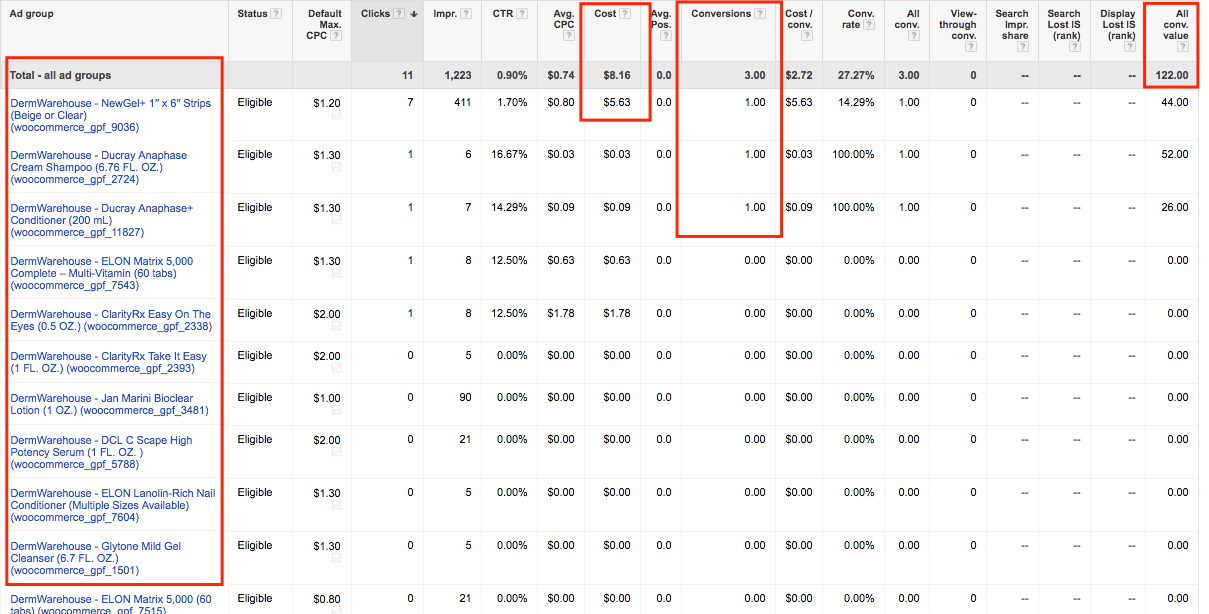
Below is an example of campaign segmentation for the top 30 selling products for DermWarehouse. In order to find the top selling products, there was prior segmentation based off of each brand. You can see the day I took the screen shot below, DermWarehouse spent $8.16 on this specific Shopping campaign and generated three conversions for $122 in revenue. This is a 14.95x return on advertising spend. While there wasn't a lot of money spent at the time of this screen shot, you can see how past data is being used to make Google Shopping work smarter so the campaign is profitable.
In the example above, you can see how there are different bids (default max CPC bids) for each product. You want to make sure you are bidding strategically based on the price of the product along with your profit margin.
We recommend taking the price of the product and dividing this by your profit margin. If you have a $100 product and your margins are 50 percent (after all expenses), then you are looking at $50 profit. According to SmartInsights, the standard ecommerce conversion rate percentage is 3.78 percent on desktop devices; on mobile devices, it is 1.14 percent (more on mobile bidding to come). You'd want to take $50 and multiply this by .038 to get a $1.90 bid. This is a good starting point! If you can convert above 3.78 percent on this $100 product, you'd be profitable.
Too often, ecommerce businesses will have the same bid for each product despite a drastic difference in pricing. This is a major flaw that can hold back your profitability on Google Shopping.
Any digital markter is going to tell you about the importance of mobile. The issue is that mobile has an ecommerce conversion rate of 1.14 percent, less than half of desktop.
Most advertisers don't realize that you can reduce your mobile bid adjustment, which will make your Google Shopping campaigns more profitable.
If you go to "settings" and "devices" you have the option to reduce mobile bidding. In the example below, you can see the mobile bid adjustment has been reduced by 50 percent. This has dropped the average cost per click by more than 50 percent on mobile. This is making our budget work harder on desktop, where all of the conversions have come from. While we don't want to give up on mobile completely within this campaign, we know it isn't as profitable as desktop and tablet, hence the 50 percent bid reduction.
I mentioned earlier that the standard ecommerce conversion rate percentage is 3.78 percent on desktop and 1.14 percent on desktop. This means that 97 out of 100 people who are visiting your website are not converting!
Make sure you have retargeting set up so after someone drops off your site your branded advertisement will continue to be served for up to 30 days.
There are advanced features of retargeting called dynamic search retargeting and RLSA (retargeting lists for search ads). For starters, make sure to create your first display retargeting campaign so your brand will stay top of mind to people who drop off your site.
For over 30 years, Make-A-Wish has granted the “wishes” of children with life-threatening medical conditions. You may have heard about some of their incredible work, whether in the news (Keoni and I are a big fan of the “Batkid” story) or from friends and neighbors in your own community. Make-A-Wish is an inspiring organization, and it’s my pleasure to have one of its creators here with me today.
As Frank will tell you, managing a non-profit isn’t easy. Fundraising, staying true to your mission, and planning for long-term success all take tremendous grit and integrity. In this episode, Frank walks me through how he made that happen while serving as CEO. You’ll also hear the moving story of how Make-A-Wish began, as well as Frank’s latest charitable project now that he’s moved on from Make-A-Wish.
Giving back is a huge part of my mission as a business owner. Whether it’s through organizations like Make-A-Wish or—my personal favorite—Pencils of Promise, entrepreneurs have a unique opportunity to make a serious difference in the lives of those in need. I’m brewing up some new philanthropic projects for the future, and this interview with Frank left me all the more inspired to get started. I’m so excited to share that inspiration with you, too. Enjoy!
The Will It Fly? Pencils of Promise Donors
I’m filled with gratitude for each of these listeners! During the launch of my book Will It Fly?, they purchased more than ten books. In their name, I sent a donation to Pencils of Promise matching what they spent to purchase those copies of my book.
These people are doing exciting things and I encourage you to visit their sites:
Thanks for Listening!
Thanks so much for joining me again this week. Have some feedback you’d like to share? Leave a note in the comment section below!
If you enjoyed this episode, please share it using the social media buttons you see at the bottom of the post.
If you have any questions, head on over to AskPat.com. This bite-sized show has more than two million downloads and counting!
And finally, don’t forget to subscribe to the show on iTunes to get automatic updates, or even better, download the new SPI Mobile App,nowavailable for both iOS and Android. It’s free!
A very special thank you to Frank for joining me this week. Until next time!
Knowing whether you are an introvert, ambivert, or extrovert, what your likes and dislikes are just means that you are navigating the periphery of your existence.
In this series, Open Every Door, Entrepreneur staff writer Nina Zipkin shares her conversations with leaders about understanding what you have to offer, navigating the obstacles that will block your path, identifying opportunity and creating it for yourself and for others.
Fueled by burnout, Cathryn Lavery started a side hustle with less than $500 and in two years sold more than $600,000 of products. Now she’s in the business of helping people achieve their goals.
In 2011, Lavery moved to the United States from her native Ireland to pursue a career in architecture after six years of undergraduate and graduate study. As much as she was passionate about the industry, she soon found herself feeling exhausted by long hours and pay that didn’t reflect what she was capable of.
As a way to channel her creativity into something that felt more restorative, in 2012 she started a design firm called Calm the Ham. Lavery’s beautiful prints caught on and gained a following, and the next year, she decided to leave architecture behind to dedicate herself to her business full time.
In 2015, while she was still operating Calm the Ham, Lavery started another business, BestSelf Co., to help other entrepreneurs find their way. The company, which was launched on Kickstarter and raised more than $322,000, makes products including calendars and journals and offers courses that she hopes will allow her customers hone their creativity and turn their ideas into a reality.
Lavery shared her insights about the importance of slow and steady improvement over time and what you need to remember when you go to the negotiation table.
Can you tell me about a time you needed to create opportunity for yourself or others?
When I first moved over here from Ireland, I had a job lined up at an architecture company. A week before I was supposed to start, they told me they that didn't have enough work. [So they were going to put off my start date] for six weeks. But of course when I moved here I expected to get paid in two weeks. I had to figure out how to make money before I started the job. So I started using my design skills, logos and websites, basically anything I could to get paid.
What was at stake for you? Did this experience change how you think about leadership?
I was stubborn. I didn't want to call my parents and say, "Oh, this thing I told you I was coming out here for didn't work out." I didn't even tell them, actually, until a while later. I just learned that you have to count on yourself and create your own opportunities. As far as a job goes, a lot of people think that getting a traditional job is a safe way to go, but you can be let go or get fired [at any time]. Whereas if you start a business, and you [grow your own customer base] there's not one single point of failure.
What personal traits or strategies do you rely on to create opportunity for yourself and others?
I alway want to learn and better myself. When we're at school, we're told we should learn, and then you get out of college and there's nobody there. Often I feel people don't really know that they love learning because nobody is forcing them to do it anymore. But I think if you're constantly learning and trying to better your skills, being a jack of all trades [in this economy] is going to get you a lot of different opportunities that might not have happened before.
My design experience and learning about entrepreneurship and business has helped me a lot. I didn't go to business school, I didn't get an MBA. I literally had no business classes prior [to starting my company]. I just learned a lot and read a ton of books. Just being open to learning every day and trying to make opportunities for yourself to improve [will help you go far].
It's that marginal 1 percent improvement. If you improve 1 percent a day, you'll be three times better in a year. You want to get that quick win, the instant gratification, whereas the things that will actually help you move forward are the things that compound on each other [over time].
When you experience a setback, what do you do to keep going? How do you get unstuck?
I try to take some time off and do some thinking. I used to just try to push through it harder, but I feel like I've learned that doesn't really work. I've gotten burned out from trying to just force it to be better. And now I stop, reflect on what actually happened and then see if there's like a way around it. Exercise works. If I do some sort of exercise, then my head clears up. Pausing and doing something physical that moves your body, as easy as going for a walk, is a really underrated thing you can do to get unstuck.
People who want to advocate for themselves don’t know always know how. What are actionable steps they can take to make themselves heard? What steps do you take?
If you can advocate for yourself while telling the other person what's in it for them, [that will make an impact]. lf it's a promotion, [think about] what have you been doing and what do you want to do extra that will get you to that point. So really selling it on what does success look like for them, if you got this promotion. Or if you're fundraising -- I've raised money on Kickstarter and it's not because people want to support me. It's really selling them on what the idea is. What is the product going to do for their life? So I think it's finding out what the other person wants and then advocating for yourself by telling them why it's going to work out well for them.
Has there been a counterintuitive or surprising way you've opened doors for yourself?
I'm an introverted person generally. I do like connecting with people, but I need my time alone. What I find is I like meeting people, but my way in is finding a way to help them with something. We got a huge blog post opportunity for our Kickstarter, because I started a relationship with this person over email [when I helped them with a design issue]. Then we ended up getting into a conversation. It's things like that. So it's really just helping people without asking for anything back. What can you do that's small? Make the most of these little opportunities [and that reciprocity will come back when you need help with something].
Was there a blindspot that you had about leadership and opportunity you worked to change within yourself?
I didn't like [the idea of being a] manager because I thought it was so boring. Our team has grown from myself and my co-founder to now 16 people. Now I see leadership is asking yourself: How do you motivate each person in their own way? Every time we hire someone we'll find what their love language is. If they did a good job on something, how do I motivate them and inspire them and be thankful in a way that they will actually appreciate? So now I see it more as individual leadership over the team instead of one-size-fits-all, which is what my perception was before.
This post is something I wrote a while back, but I thought I’d re-post because it had such a huge impact on me and my business. It’s a timeless lesson, really, and something I think we can all pull from and apply to our own lives. I updated a few sections, but other than that it’s as it was back then. I hope you enjoy!
Around 2010, my wife and I had what was probably one of the most conversations ever, and it’s directly related to what I do online. It’s a conversation that I will never forget because it had a lasting impact on my life as an online entrepreneur, but also on my life as a parent and a husband.
This is a conversation I had when our first child was just a baby. Because of this conversation, I’m able to be more focused on my work, and therefore very present and available to my kids, which means the world to me. It just goes to show how business lessons can apply and have such positive affect on our personal lives too!
The Issue
The subject of our discussion was my work schedule. The problem was: I didn’t have one.
As someone who has been somewhat successful online thus far earning a passive income, I do have the ability to work fewer hours, and if I really wanted to, not work at all. However, having this freedom to work whenever I want has put negative thoughts in my head about adhering to an actual schedule.
Why would I want to “force” myself to a schedule and work during specific hours of the day, when I have the freedom to work whenever I want?
I now know the answer.
The Problems
There were a few problems with the lifestyle I was living prior to this life-changing conversation:
1. It was hard to decipher when I was working, and when I was not.
Because I wasn’t on a schedule, it was often hard for my wife to know exactly when I was busy, and when I was not. Sometimes I’d be in my office doing work-related things, and sometimes I’d be in my office doing non-work-related things. If she wanted to talk about something, or needed some help with the baby, sometimes I’d be in the middle of something important, and sometimes I wouldn’t. It was tough for both of us.
2. Work was never “done” for the day.
As I’ve mentioned in the past, working from home is tough. It takes a lot of discipline to really clear your head of work-related items when you’re not working, because those work-related items can so easily be done at any time of the day.
Although my current income streams only require just a few hours of work per week, I spend a lot of my extra/free time working on new projects to diversify and expand my passive income portfolio. Because of this, I feel like I could always do more work. And that’s exactly what I ended up doing.
I compare it to a piece of artwork, or a painting—how do you ever know when it’s finished? It just seems like there’s always more you can do to make it better.
Not having a schedule made it really hard for me to stop.
3. Randomness.
Not adhering to a schedule = total randomness.
This is a tough one, because a lot of us want to break free from that 9-to-5 schedule where it seems like everyday is exactly the same (I was there not too long ago). But at the same time, it’s that schedule that keeps a lot of our lives sane and less chaotic.
With a different schedule every day of the month, you can imagine how hard it was for my family and friends to understand when I was available, or when it was okay to plan certain things that may involve me one way or another. Now, especially with a baby in the house, sticking to a schedule is more important than ever.
The Solution
My wife and I (civilly) came up with a solution for this dilemma. It’s basically a two part solution:
Create a schedule
Separate work stuff from non-work stuff
Creating a Schedule
It was obvious that I needed to create a schedule, again not only for my wife’s sake, but for my own as well. Both she and I would then have a clear understanding of when I am working and unavailable (except for emergencies, obviously), and not working.
Before creating a schedule, I gave myself some guidelines:
I didn’t want a straight 9-to-5 schedule.
I wanted a long lunch.
I wanted to allocate time on Sunday, Tuesday, and Thursday night to write blog posts for SPI, since I know that’s when I write my best material.
I want the schedule to be flexible, meaning I could trade time here and there throughout the week.
The nice thing is that if I don’t have anything to work on, I could really easily just scrap those hours for the day and not worry about it. However, if I do have work to do, we all know exactly when that work is supposed to happen.
Separating Work Stuff from Non-Work Stuff
How many times during the day are you actually working when you’re supposed to? Probably not as much as you should.
I wasn’t.
In fact, after literally keeping track of everything I did during a normal day, I noticed some rather disturbing issues, especially when it came to checking my emails, checking website stats, opening my Facebook account (personal, not the SPI page), and reading the news.
Basically, I did a lot of non-work-related things when I was supposed to be working. On the flip side, I was working (or thinking about work), when I probably shouldn’t have been.
So, how did we solve this problem?
It may sound a little odd to you, but I purchased a new MacBook Pro laptop computer.
Here’s why (and no, it wasn’t because I wanted a new laptop. That wasn’t even on my mind until this came up):
The computer in my office (an iMac) is where I did everything, including all of those personal things. It was hard for me personally to keep those things totally separate. By buying a laptop that is specifically just for personal, non-work-related items, I can more easily focus on work when I’m supposed to work, and not be tempted to work when I’m doing personal stuff.
Furthermore, because the laptop is portable, I can literally separate work from non-work stuff by keeping the office and the computer in it off limits during non-work hours.
I deleted all of my personal email accounts from my mail client on my work computer. I imported all of my personal bookmarks and files into the laptop, and deleted them from the iMac. All of my instant messaging and chat software (excluding Skype, which I use for business only), has been transferred as well.
In the past couple days, living with this new setup, I’ve begun to notice major changes in my life, both in how much work I’m actually able to get done, as well as how I feel when work is “done” for the day. I’m more able to enjoy time I spend not working, and life just seems that much better now.
Present Note:
Looking back on this now, I was making the small steps toward a mindful separation of my work life and my personal life. Today, I’ve taken this concept even further with an office dedicated to my work-related stuff only. When I’m in the office, I’m in work mode, and my family knows that. But when I’m not in the office, I can be totally present for my family, which is the best! I also, rather than spending my non-work time on my iMac, I now have my phone for non-work things. Check out my current home office setup in the photo below. For an even closer look, watch my office tour in SPI TV Ep. 2.
My Final Thoughts
I’m really glad my wife and I had this discussion, and I think it’s one that everyone should have because it’s really easy for work-related things to get out of hand, making us forget sometimes why we’re really working in the first place.
And even if you’re single, it’s important to understand these principles too. Especially when it comes to knowing when work is done, so you can really enjoy your time to play.
If you do any kind of work from home, do you work on a schedule? How do you make sure you keep business and non-business-related things separate?
Thank you so much for your support, and I hope you found this post valuable as a blogger, entrepreneur, employee, husband, wife, or person.
Apple’s new $5 billion space ship headquarter has a major problem. It seems their employees are walking into the glass wall that surrounds the building and hurting themselves! Also in the Dot Com Lunch, the founder of the 90 video challenge fails the challenge. That means more money for me!
Anyone is welcome to join us for the Dot Com Lunch. Sign up at our Dot Com Lifestyle Meetup page to find the time and location of the next get together.
The benefits of creative thinking are enumerable. Having this skillset will enable you to tackle problems with unique perspectives, come up with special ideas and, overall, be a more effective performer.
One challenge to becoming more creative is the difficulty of quantifying creativity. It is much easier to learn and subsequently demonstrate skills in software engineering, for example. That being said, companies and people are drawn toward creative thinkers. The more that those around you listen to your opinion and the more frequently you propose unique ideas, the higher an indication of these skills. Therefore, over time, you can gauge progress based on how others respond to you and your work.
The other challenge, though, is that sometimes others will not recognise your creativity. They might shoot down an awesome idea because it sounds crazy unconventional. Understanding this and learning to navigate it will keep your confidence levels high so that you can continue to grow.
With these perspectives in mind around quantifying creativity, here are nine guaranteed ways that you can become a more creative thinker to better tackle your life and problems:
1. Read
People have chronicled years of their work or life experiences into books. Knowing more and having different perspectives will help you become more creative. You will be able to take others’ ideas, pieces of knowledge and individual experiences and apply them to your present situations. Reading is one of the best ways to pick up this knowledge and empathy.
It is easy to make excuses for not having enough time to read but if you make reading a priority, you will be able to find the time and undoubtedly become more creative.
Having some sort of artistic outlet in your life will dramatically help with creativity levels. Albert Einstein came up with many of his famous revelations while playing the violin.
In the book Originals, Adam Grant – a researcher and professor at Wharton – found that “Nobel Prize-winners are twice as likely to play a musical instrument, they’re seven times as likely to draw or paint, 12 times as likely to write fiction or poetry, and… 22 times as likely as their peers to perform as actors, dancers, or, yes, magicians.”
Whether it be an instrument, drawing, acting or anything else, finding an artistic outlet will fire different parts of your brain. Those spark serenity and a stillness that will make you a more creative person.
3. Surround yourself with a wider range of personalities
Empathy is a huge key to creativity. Most people surround themselves with others who are similar to them. While doing so is comfortable, it is not beneficial when working toward creativity.
There are others within your vicinity who have lived dramatically different lives. Meeting them, understanding their backgrounds and learning how they think will widen your perspective about the world. That will, in turn, increase the creative vigor you can take through life.
4. Spend more time in nature
Being outdoors also sparks creativity. Escaping from the stresses and routine of life, even for brief periods, can get your head out of a rut. Finding short times to be outside throughout your week will give you a chance to get away from all of the technology and noise in our daily lives. Plus, it is an excuse to go have fun and explore.
Mental stillness allows you to eliminate many of the thoughts that constantly ruminate in your head. When you are always thinking about a past or future event, for instance, it takes your mind away from tackling the current situation. Meditation is a great way to develop this stillness.
With a meditation practice you can learn to let your mind be entirely in the present situation. Doing so will allow you to exert more concentrated effort on the tasks at hand. You can pull in more knowledge from different parts of your brain. Consequently, you will be more creative in each moment.
6. Get enough sleep
Lack of sleep can kill creativity. Although we feel the urge to always be on the move, when we are tired, we are not able to use as much of our brain. Plus, exhaustion makes it harder to retain information upon learning it. Therefore, with less sleep, we learn less that we can apply to situations and we cannot perform as effectively on any given task. Making sleep a priority will help your creativity, without a doubt.
7. Exercise
Feeling healthy is a great way to have more confidence throughout our days. This confidence often leads to less worrying and more mental energy being exerted at the task at hand. Plus, while actually working out, people tend to be hyper-present. This might trigger an idea or a thought you had not considered before.
8. Do more of what you love
There is a correlation between happiness and creativity. The better that our spirits are, the higher functioning we act on a daily basis. Subsequently, a great way to increase happiness levels is to do what you love. This could be hobbies, spending time with loved ones or anything else.
Additionally, when doing what we love, we tend to be in a very present state. Some have called this state ‘flow.’ As mentioned above, being in a present state pays large dividends toward creativity. Not to mention that doing what you love might spark additional ideas and help you find new interests where you can be creative.
Taking risks will boost creativity by giving you a larger set of life events. When you have experienced more things, you will be able to apply those memories and lessons to each new situation that you are in. While you can do more in life without taking risks, fear is often an inhibitor toward trying something new. Therefore, be open to taking more chances. By going out of your comfort zone and doing what others might be unwilling to do, you will develop a deeper breadth of memories and past experiences that you can apply to new problems.
This article was originally posted here on Entrepreneur.com.
Among employers offering wellness programs, more than half saw a decrease in absenteeism; 66 percent reported increased productivity.
7 min read
Opinions expressed by Entrepreneur contributors are their own.
Right now, we're smack dab in the middle of flu season. I got sick a while back, and it took me weeks to shake it off. And virtually everyone in my Sioux Falls office has done battle with a cold or the flu. Overall? Few people have been lucky enough not to get sick . . . yet.
Coming down with a cold or the flu has nothing to do with your fitness level or habits. Yet, companies are investing in the well-being of their employees by establishing wellness programs in an effort to not only to keep their staffers healthy, but to save money on rising healthcare costs.
Wellness programs' reach
Corporate wellness programs are nearly an $8 billion industry in the United States alone, and the segment is expected to grow another 7.8 percent by 2021. Globally, it’s a $40 billion industry, despite the fact that approximately only 9 percent of the roughly 3 billion global workforce has access to wellness programs, according to the Global Wellness Institute.
In recent years, a shift has occurred in the way we view not just fitness but overall wellness. According to the Centers for Disease Foundation, worker illness and injuries cost U.S. employers $225.8 billion annually, or $1,685 per employee. In addition, $1 trillion is lost due to unaddressed employee chronic disease each year, according to the Milken Institute.
As baby boomers have begun to retire, millennials have become the largest generation fully employed. As a result, many companies have wellness programs in place, because of their allure for young professionals. And that allure extends beyond millennials, because professionals of every generation today are more in tune with their health and well-being than ever before.
That makes wellness programs less of a perk than a routine offering. The result is that more than 9 in 10 organizations offer at least one wellness initiative, according to a 2017 survey by the International Foundation of Employee Benefit Plans. And the reason for these initiatives' popularity is clear: Wellness programs provide busy employees and executives opportunities to improve their health without sacrificing their free (or family) time.
Those opportunities come down to five critical benefits that today's wellness programs can offer:
Improved employee health behaviors
Reduced risk of elevated health risks
Reduced healthcare costs
Improved productivity
Decreased absenteeism
Behavior patterns
What's also significant about wellness programs is that they are designed to change the behavioral patterns that can lead to chronic illness like asthma, heart disease, obesity, cancer and diabetes. Forty-five percent of the population has at least one of these chronic diseases, which are responsible for 7 out of every 10 U.S. deaths.
That's why when employees change their behavior, the result is lower healthcare costs for employers. A study by the University of Louisville found that every dollar invested in a wellness program generated $7 in healthcare savings. The study also revealed that changing certain behaviors decreased the average number of health risks among employees from 5 or more health risks to 0 to 3 risks.
Productivity
Productivity is another factor affected when employees aren’t at their best, physically and mentally. Poor employee productivity refers to a scenario where someone is physically present at work, but "not there" mentally. The cause can be multiple factors: lack of sleep, headaches, mental health problems or even financial problems. A survey by the Employee Benefit News magazine said that 31 percent of respondents rated mental illness as the number one reason for loss of productivity.
This is important, because with one in four adults experiencing some type of mental illness, wellness programs have become about more than just physical health. That's why adding mental illness to overall wellness is now synonymous with physical wellness. We all lead fast lives, and that can cause our stress levels to skyrocket.
Lack and loss of productivity due to health reasons can also lead to absenteeism. According to a CDC study, absenteeism costs small employers between $16 and $81 per employee annually, and large employers between $17 and $286. The International Foundation of Employee Benefit Plans survey also found that among employers offering and measuring wellness efforts, more than half saw a decrease in absenteeism, while 66 percent reported increased productivity and 67 percent said employees are more satisfied.
It’s no secret that healthy employees are productive employees, but employers and corporate leaders need to ensure that wellness programs are all-encompassing. They need to recognize that the more they invest in their employees, the more they get back. It’s that simple.
What about the C-suite?
With employees taken care of, what about corporate leaders and other busy, jet-lagging C-suite executives?
If you’re anything like me, you're always on the go -- always moving from one city to the next, event after event. I will admit that my health hasn’t always been a priority for me; going to the doctor was always a last-minute resort, even when I needed surgery for a detached retina. From that experience, I learned that our health is our most valuable possession.
And that reminds me of comments I heard from Ari Cukier, COO of Elitra Health. Cukier was one of many interesting business executives I meet for my podcast. And during our interview he explained the importance of establishing and maintaining a healthy lifestyle and how important it is to receive preventive care.
He also talked about the need he sees within the executive industry because, he said, these people don’t practice what they preach. Specifically, they want their employees to be physically and mentally fit, but they’re always postponing their own doctors’ visits or not even bothering to make appointments because of their busy schedules.
That's where Cukier's company comes in. By having all of the necessary equipment and testing in one facility, Elitra hopes to change how executives approach their health and wellness.
Another big change in workplace healthcare: data integration
Other changes in health are coming or are already in place, and that includes data integration. Anything from software platforms to wearables can customize important information for employees seeking to change their lifestyles and obtain results. And employees want these this technology: A UnitedHealthcare infographic revealed that 62 percent of employees who didn't have an activity tracker were interested in using one as part of a work wellness program.
What you as a leader can do
One thing you can do is ensure your employees take the vacation time they are allotted. Americans, on average, have a total of 10 paid vacation days a year, which is well below that of our European counterparts, who get between 20 and 30 paid vacation days annually.
In 2016, the amount of time off earned by U.S. employees increased nearly a full day, but despite that increase, a smaller percentage of employees (54 percent) ended the year with more unused vacation time than the year before (55 percent). Forfeiting vacation days means that workers gave up $66.4 billion in benefits throughout 2016, costing the U.S. economy $236 billion.
It's important for corporate America (and small business owners alike) to immerse themselves in employee wellness. The trend encourages workers to stay healthy, happy and productive even as their employers reap savings from their efforts.
From a financial perspective, you don’t absolutely need corporate resources to ensure your employees are well taken care of. But whatever you offer or don't offer, in the end, nurturing a culture of wellness at your company can only ensure you have a group of people giving you their best all the time.
Videze is a powerful cloud based app that lets you create any type of stunning animated video with just a few clicks….
Videze is a powerful cloud based app that lets you create any type of stunning animated video with just a few clicks. Videze is your complete all-in-one software solution that allows you to create high quality mesmerizing animated logos, lower thirds, intros and outros, 3D live action videos, whiteboard & explainer videos, kinetic typography videos, slide show and promo videos, and much more.
Videze is the only all-in-one full-featured web based app that takes the latest video technology, and lets you create any type of epic Hollywood style animated video with your brand, text, images and logo in mere minutes. Videze works for anyone including newbies with no tech skills (and no prior experience needed.) You can finally produce blockbuster cinematic Hollywood style videos that will “WOW” all your viewers and blow all your competitors out of the water.
Why I Love Videze
I love Videze because it’s really easy to use and creates amazing looking result fast. It works in 3 easy steps:
Select Template: Browse our wide range of beautifully crafted premium templates including Animated Logos, Promos, Kinetic Typography, Live Motion, Slideshows, Whiteboard, Explainer and more. Whatever you need, we’ve got it!
Customize: Full flexibility and control to customize your video to whatever style you like… You can add your own logo, text, images and color in just seconds.
Hit “Render”: That’s it you’re done. Simply sit back, relax and grab a cup of tea while Videze works it’s magic to make you stunning cinematic HD videos in just a few minutes.
Bonus #1)Healthy Wealthy Academy: Healthy Wealthy Academy gives you access to several internet marketing courses. This usually is a $297 course alone!
With HWA you’ll learn the basics of setting up your own website, how to start freelancing, how product launches work, ranking videos, paid traffic techniques – and many other online marketing strategies and tactics.
Bonus #2) YouTube Marketing Excellence: Your complete guide to YouTube marketing and how to become an expert in generating commissions with Youtube. The package includes Training Manual, Cheat Sheet, Mind Map and Resources Report. Follow the steps in this training manual and start getting traffic and sales!
Bonus #3) Need For Speed Course: This hefty pre-selling course contains everything you need to be a preselling master. Imagine being able to write highly engaging and shareable content within hours, instead of days or weeks.
Bonus #4) Niche Research Manual: In this manual, you’re going to learn exactly how you can perform affiliate niche product (and keyword research.) As you probably already know, niche research is one of the most initial and crucial steps in your Internet affiliate marketing journey… It does not matter if you’re selling your own or someone else’s affiliate product, niche research plays a BIG part in your entire Internet marketing success.
Bonus #5) 2,750 ‘Done For You’ Niche Keywords Data Pack: This secret classified datapack reveals highly profitable niche keywords to target, monthly search volume & how easy it is to rank them to get page 1 rankings at will. Cutting out all the time spent of having to do keyword research manually. With this bonus, you can easily rank videos and start bagging commissions quickly…
Bonus #6) Facebook Advertising For Beginners: This beginner’s course in Facebook ad shows you from beginning to end, the whole fb ads platform in a newbie friendly way. In this you’ll learn how to setup your very first ads campaign, and learn about the the facebook pixel, and how it works.
Disclosure: The operator of this website is a 3rd party marketer with a material connection to product/service providers appearing on this site in that we are compensated for sales made through our affiliate links.
If you have any questions please contact me (Bill) at beachroulette@gmail.com.


 Pre-launch buzz-building social media strategy for Will It Fly?



 Having some sort of artistic outlet in your life will dramatically help with creativity levels. Albert Einstein came up with many of his famous revelations while playing the violin.
 Being outdoors also sparks creativity. Escaping from the stresses and routine of life, even for brief periods, can get your head out of a rut. Finding short times to be outside throughout your week will give you a chance to get away from all of the
  Feeling healthy is a great way to have more confidence throughout our days. This confidence often leads to less worrying and more


